
Sutton County Projected Release Meaning
A projected release date is a calculation, not a gate log. TDCJ defines it as the date calculated by its Classification and Records Office when a state inmate is expected to leave incarceration if parole does not occur sooner. The date depends on the governing sentence and law. It may shift before the person leaves.
An actual release date records the end of confinement by that custodian. Discharge is different again. TDCJ uses discharge for completion of the sentence and release from incarceration, parole, mandatory supervision, or community supervision. A person can leave prison on parole and remain under the sentence for years before discharge.
A Sutton County pretrial detainee has no computed TDCJ date. Bond, dismissal, a court order, another warrant, or a detainer may control the next event. Even when a judge authorizes release, Sutton County Jail must complete processing and check for other holds. The court record explains authority; the Sheriff event confirms movement.
Find Sutton County Projected Dates
First identify the custodian. TDCJ holds sentenced state prisoners, while Sutton County Jail holds local detainees and some county-sentenced people. A person arrested in Sutton County does not belong in the state search unless the person was later committed to TDCJ. Federal custody uses the BOP system and falls outside both routes.
- Decide whether the person is in Sutton County Jail, TDCJ, federal custody, or another named facility.
- For TDCJ, search by seven-digit TDCJ number or SID number when possible. A name search can be narrowed by gender and race.
- Open the correct state result and note the location, sentence, county and court, projected release date, and parole-review fields.
- For a county term, obtain the judgment and jail-credit record, then ask the Sheriff for the county calculation or actual event.
- Confirm a state departure through the applicable TDCJ status line before making plans around the date.
The TDCJ Online Inmate Search displays the fields used to find a sentenced prisoner’s Sutton County projected release date.
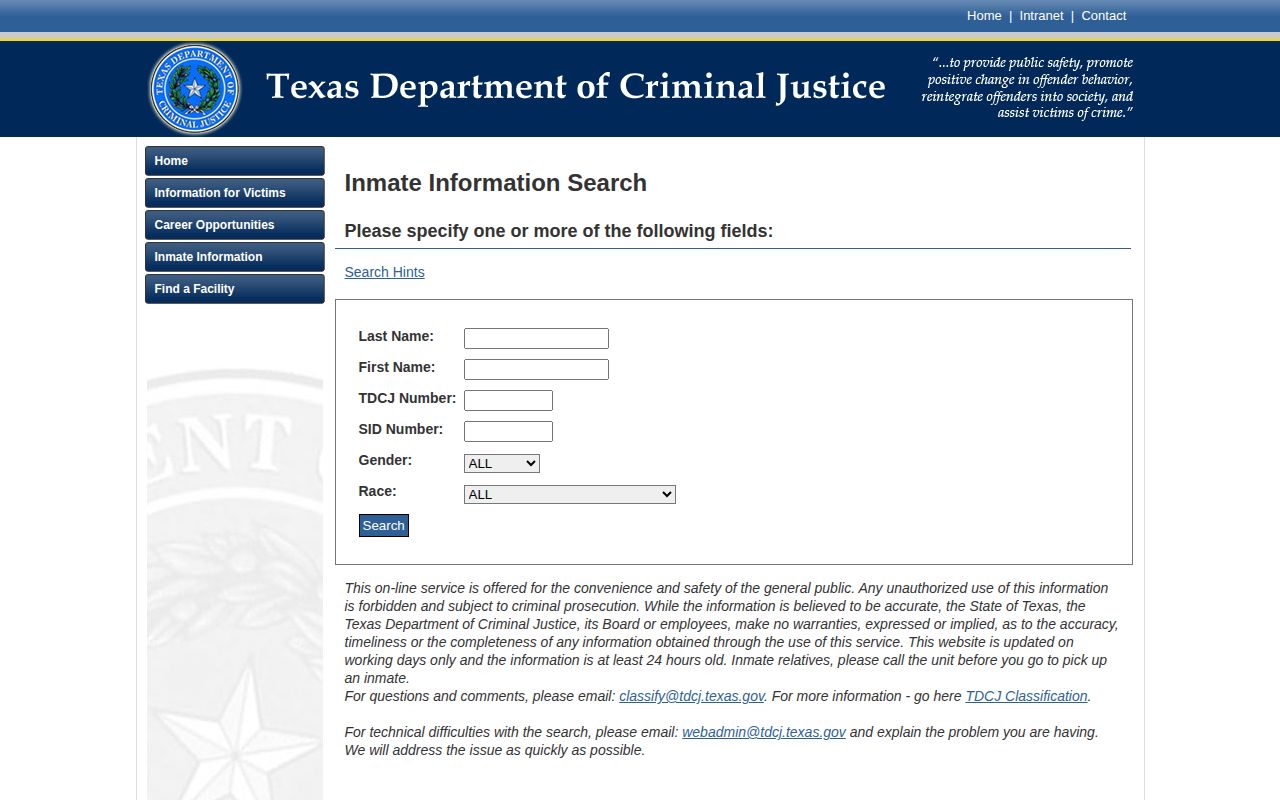
The screen also warns that public information is updated on working days and remains at least 24 hours behind current operations.
Sutton County TDCJ Date Fields
TDCJ public information can connect a person to the correct sentence and calculation. Compare identifiers before relying on a similar name. The conviction county or court field can help show whether the record concerns a Sutton case, but TDCJ remains the authority only for state custody.
| Field | Use in a release date lookup |
|---|---|
| TDCJ or SID number | Provides the best match to the intended state prisoner. |
| Current location | Identifies the TDCJ unit or status tied to the public record. |
| Offense, county, and court | Connects the sentence to its legal source and governing dates. |
| Sentence information | Supplies the term used in the statutory calculation. |
| Projected release date | Shows the current forecast, not confirmed departure. |
| Parole-review information | Shows review status that may affect the path or timing. |
The TDCJ no-charge email information route can supply the TDCJ number, location, offenses, prior incarceration history, current offense and court, and projected release date. Send the full name and TDCJ number to pia@tdcj.texas.gov. If the number is unknown, use the exact date of birth, or an approximate age and county of conviction when necessary.
The official email-information screen lists those available fields.
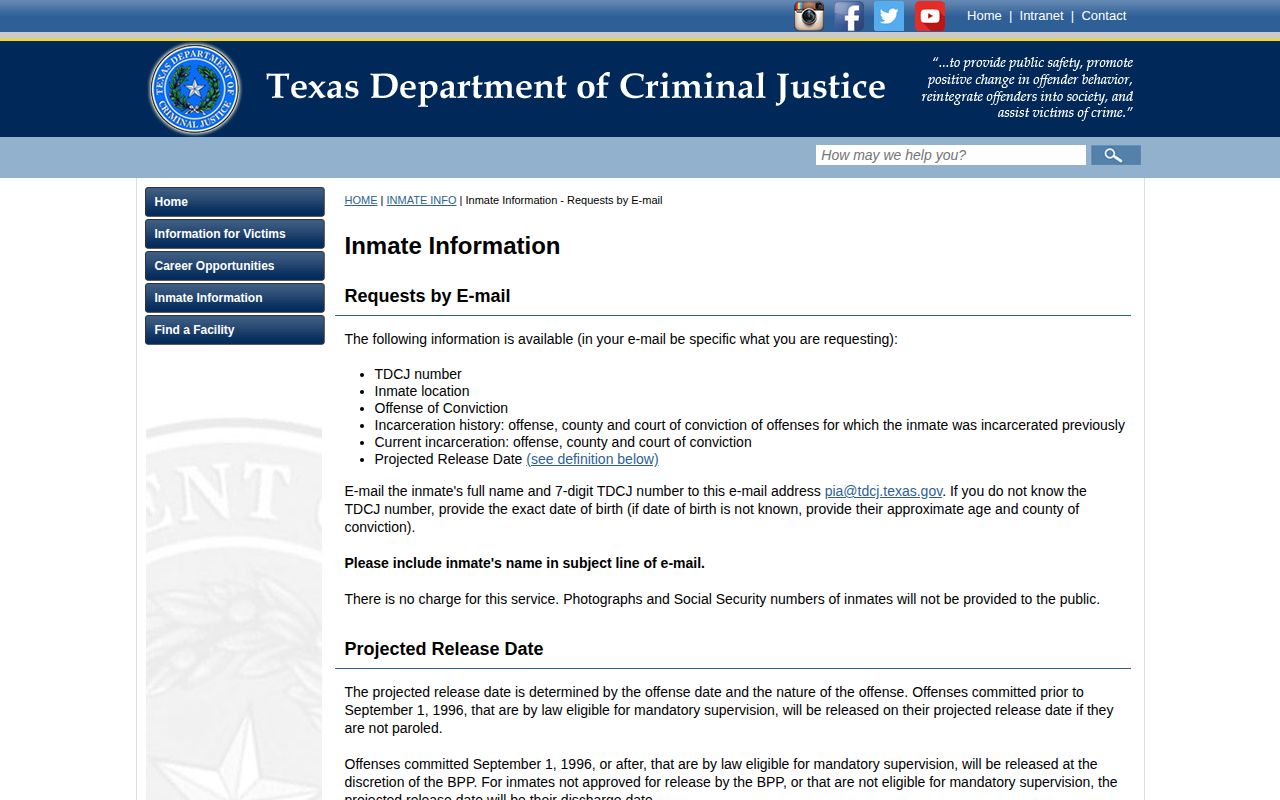
This fallback is useful when the public search does not answer the question, but a historical record request is needed for an actual past release or discharge event.
Texas Release Projection Categories
TDCJ describes three broad projection settings. Offense date and eligibility matter, so the category cannot be chosen from sentence length alone. These rules apply to a state prisoner, not to a person serving an ordinary Sutton County jail term.
- Eligible offense before September 1, 1996
- The projection may be the scheduled mandatory-supervision date when flat time plus good time equals the sentence, unless parole happens first.
- Eligible offense on or after September 1, 1996
- Discretionary mandatory supervision requires BPP approval. Denial may move the date to maximum expiration, while later approval may move it earlier.
- Mandatory-supervision-ineligible offense
- The projection generally follows maximum expiration based on flat time unless parole occurs first.
Maximum expiration is the sentence end as calculated from the controlling records. Mandatory supervision is a statutory form of release for eligible cases. For many eligible post-1996 cases, the Board may deny release after reviewing the statutory factors. Neither eligibility nor review creates a promise that the person leaves on a certain day.
Note: A later Board decision can change the displayed projection without changing the original sentence imposed by the court.
Sutton County Texas Good Time
Texas does not have a blanket rule that every state prisoner must serve 85 percent of a sentence. Good-conduct time depends on classification, conduct, and program participation. Under Texas Government Code Chapter 498, classification and accrual are governed by section 498.003, forfeiture and restoration by section 498.004, and section 498.005 states that good time is not vested. Nonvested time can be lost and is not the same as actual calendar time served.
For cases governed by Government Code section 508.145(d), including serious offenses identified through Code of Criminal Procedure article 42A.054 and other listed offenses, parole eligibility generally requires actual calendar time without good-conduct time equal to half the sentence or 30 calendar years, whichever is less, subject to the subsection’s minimum rules. “3g” is old shorthand and should not replace the current statute.
State-jail felonies are not parole eligible under section 508.145(f). Section 508.149 separately excludes many cases from mandatory supervision. These rules govern state calculations. Sutton County publishes no county-jail good-time policy, weekend-release rule, or online sentence calculator, so no TDCJ formula should be copied onto a county term.
Sutton County Release Date Changes
A projected date can change for more than one reason. The public field reflects the records and law known to TDCJ when it is calculated. New sentence data, a change in credit, Board action, or another authority’s hold may alter the expected path.
| Factor | Possible effect |
|---|---|
| Good-time forfeiture or restoration | Changes eligible credit under Chapter 498 where the governing law permits it. |
| Corrected sentence or jail credit | Changes the legal inputs used in the calculation. |
| Consecutive cases | Requires sentences to run in the court-ordered sequence. |
| Detainer or warrant | May cause transfer or continued custody even when one sentence reaches a date. |
| BPP denial or approval | May move a discretionary mandatory-supervision projection to maximum expiration or back toward release processing. |
| Parole action | Can create an earlier supervised-release path, subject to processing and any conditions. |
A detainer is a notice that another authority may seek custody. It can turn an expected release into a transfer. A favorable parole vote can also contain a program, transfer, or set-period requirement. Physical release must still be confirmed after the vote.
Why Sutton Release Dates Move
Texas has a distinctive projection change after discretionary mandatory-supervision review. When BPP denies that release, TDCJ may recalculate the projected field to maximum expiration. If a later review leads to approval, the date may move earlier again as release processing begins. The field is therefore not a fixed gate appointment.
This state process must stay separate from a Sutton County sentence. The county publishes no calculator, good-time schedule, weekend practice, or standard release hour. Obtain the judgment, sentence credit, and Sheriff calculation. Then request the actual booking event once release occurs. Guessing from a TDCJ rule could produce the wrong date for a local term.
Sutton court records can supply the legal inputs. County-court misdemeanor and district-court felony records are online from 1992 forward, while older files require the Clerk’s manual or form route. Ask for the judgment, sentence, order crediting time served, bond order, dismissal, or commitment that fits the case. A docket entry may show a bond type or amount, yet it does not prove the Sheriff accepted the bond or completed release. Use the cause number when asking the jail to match the court action to the booking.
Does a favorable BPP vote establish release? No. It means the Board acted favorably on the review. Programs, transfers, reconsideration, warrants, detainers, and release processing may still stand between that vote and departure.
Note: Confirm timing with the unit or release-processing office before arranging travel or pickup around any projected date.
Confirm Sutton County Release Dates
TDCJ assigns different phone routes to stages of the state process. Before a BPP vote, call 844-512-0461 for parole-review status. After a favorable vote, call TDCJ Parole Division release processing at 512-406-5202. The general locator is 936-295-6371 or 800-535-0283. Published hours are weekdays from 8 a.m. to 5 p.m.
For Sutton County Jail, call the Sheriff at 325-387-2288. Ask whether the named booking ended, the release date and time, the disposition, and whether another agency received the person. A court order for bond, dismissal, or time served can explain why release was authorized, but another warrant or hold can delay physical movement.
A Sutton County VINE Inmate Check may provide a release or transfer alert when the agency offers that event. Use the notice as a prompt to verify, not as the sole historical record. TDCJ data can lag by at least 24 hours and is updated on working days, so a same-day public screen may not match unit operations.
For a past TDCJ event, request records that state admission date, actual release date, release type, discharge date if different, units of confinement, identifiers, offense and court data, and parole or mandatory-supervision dates. That history resolves a common ambiguity: leaving prison and completing the sentence are not the same event. For a past county event, request the Sutton booking’s release date and time, reason, and receiving agency. Keep the requests separate because neither office maintains the other system’s record.
- Label a displayed date as projected until departure is confirmed.
- Record the source, person ID, status date, and check time.
- Use the post-vote line only after a favorable BPP decision.
- Ask the Sheriff for a county release or transfer event.
- Follow the receiving agency when the event shows transfer.