
Sutton County Parole Versus Probation
Parole, mandatory supervision, and probation are not interchangeable. Parole is a discretionary release from Texas Department of Criminal Justice incarceration. The person serves the remaining sentence under supervision. Mandatory supervision is a statutory release framework for eligible cases, with discretionary Texas Board of Pardons and Paroles approval required for eligible cases after September 1, 1996. Probation is imposed by a court and administered by a Community Supervision and Corrections Department, or CSCD.
| Supervision type | How it begins | Sutton County route |
|---|---|---|
| Parole | BPP approves release before the sentence ends. | TDCJ search, BPP status channels, then the assigned parole office. |
| Mandatory supervision | An eligible state case reaches the statutory framework and required review. | TDCJ and the assigned parole office, like parole. |
| Probation or community supervision | A court orders community supervision instead of, or after, confinement as the judgment provides. | The multi-county CSCD route in the official state locator. |
A Sutton County arrest does not decide which row applies. The controlling event may be a TDCJ prison release, a local court judgment, or the completion of one type of supervision. Start with the record that created the status. Do not send a probation inquiry to a parole office merely because both may require community reporting.
- Releasee
- A person released from TDCJ incarceration while still under parole or mandatory supervision.
- Discharge
- Completion of the sentence and release from incarceration, parole, mandatory supervision, or community supervision.
- Absconder
- A person alleged to have stopped complying or reporting, which may prompt the supervising agency to seek a warrant.
- Revocation
- A process that may end community supervision and return a person to custody after an alleged violation.
Verify Sutton County Supervision Status
The correct lookup starts by separating a state-prison release from court-ordered probation. For parole or mandatory supervision, use the TDCJ Online Inmate Search with a TDCJ or SID number when possible. Match the name, identifiers, county, court, offense, and sentence. Public fields can include location, projected release information, and parole-review information, but the online data is updated on working days and is at least 24 hours old.
- Identify whether the status arose from TDCJ release or a Sutton County court judgment.
- For a state case, search TDCJ and compare identifiers rather than relying on a similar name.
- Before a BPP vote, call 844-512-0461 for parole-review status; after a favorable vote, call 512-406-5202 for release processing.
- After release to parole or mandatory supervision, confirm routing through TDCJ’s county directory and the San Angelo District Parole Office.
- For probation, use the TDCJ Community Justice Assistance Division CSCD locator to find the multi-county department serving Sutton.
- Use the court judgment or docket to confirm the supervision order, term, and case identity.
Staff may limit disclosure of protected details. A public verification request should focus on correct routing and public status. Conditions, personal schedules, and case-management details are not implied by the name of an office. The Sutton County released-inmate lookup helps identify the custody system before a supervision check begins.
Note: A projected release date or favorable parole vote is not proof that physical release has occurred or that supervision has begun.
Sutton County Supervision Office Split
Sutton parole and mandatory-supervision cases route to the San Angelo District Parole Office in TDCJ Region V. Ordinary probation does not. Texas groups Sutton with Brewster, Crockett, Jeff Davis, Pecos, Presidio, Reagan, and Upton counties in a multi-county CSCD arrangement. The official state directory is the safest probation route because no reliable current Sutton government page with local CSCD hours and contact details was found.
San Angelo District Parole Office
1070 Gateway Drive
San Angelo, TX 76905
Phone: 325-947-8644
Fax: 325-947-8599
Sutton County parole and mandatory-supervision routing only. Use the state CSCD locator for probation.
The TDCJ Region V parole-office page is the source for this contact. The captured official directory page below documents the assigned office information rather than a county probation office.
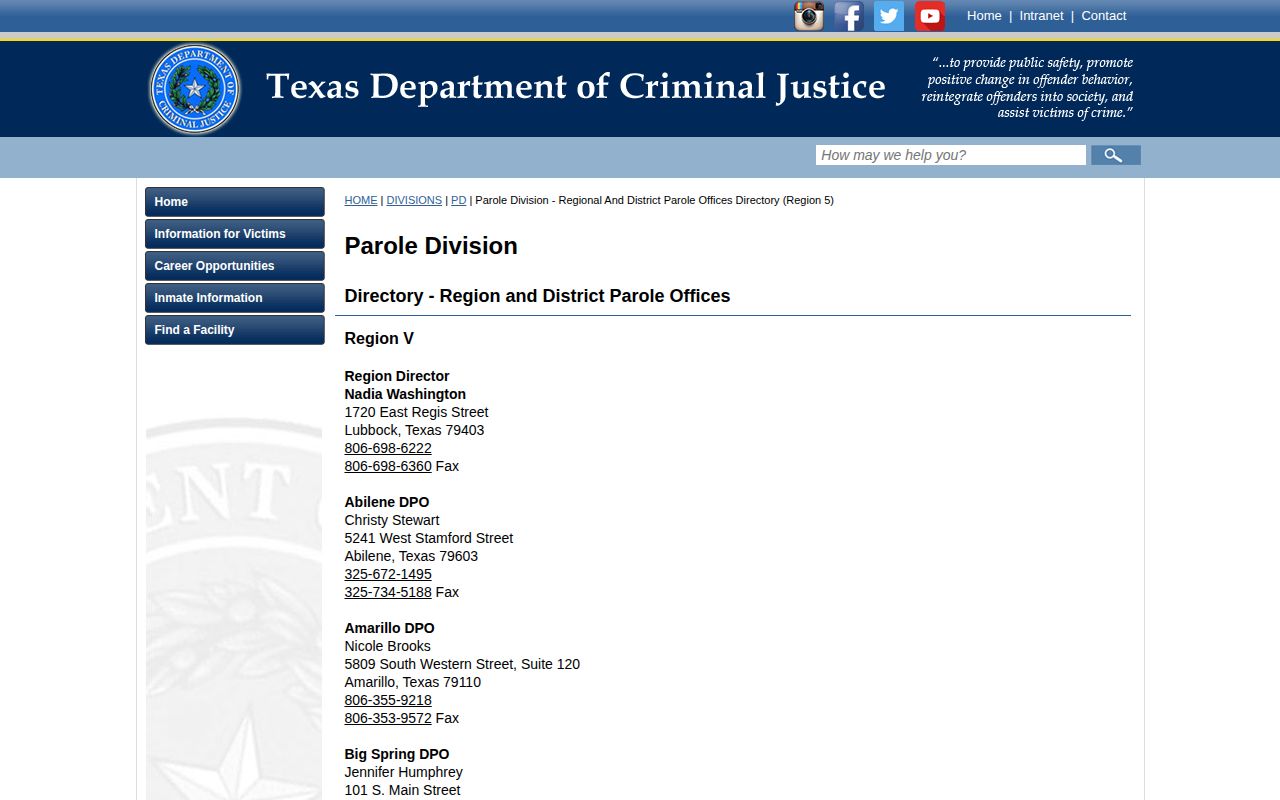
This official office listing helps prevent a wrong-office call after a Sutton County release. Confirm current routing before travel because the research does not supply public office hours.
Sutton County Parole Status Channels
TDCJ separates general inmate location, pre-vote parole review, and post-vote release processing. The distinction matters. A favorable BPP vote can include a program, transfer, or required period before release. It can also be reconsidered if new disciplinary, protest, or case information arises. “Voted favorable,” “in release processing,” and “physically released” are three different states.
The general TDCJ locator numbers are 936-295-6371 and 800-535-0283, with published telephone hours of 8 a.m. to 5 p.m. Monday through Friday. Use 844-512-0461 before a Board vote. After a favorable vote, use 512-406-5202 for release-processing status. Once a release to supervision occurs, the San Angelo office supplies the Sutton County parole routing.
The official TDCJ telephone-information page describes these status lines. Its successful source capture appears below.
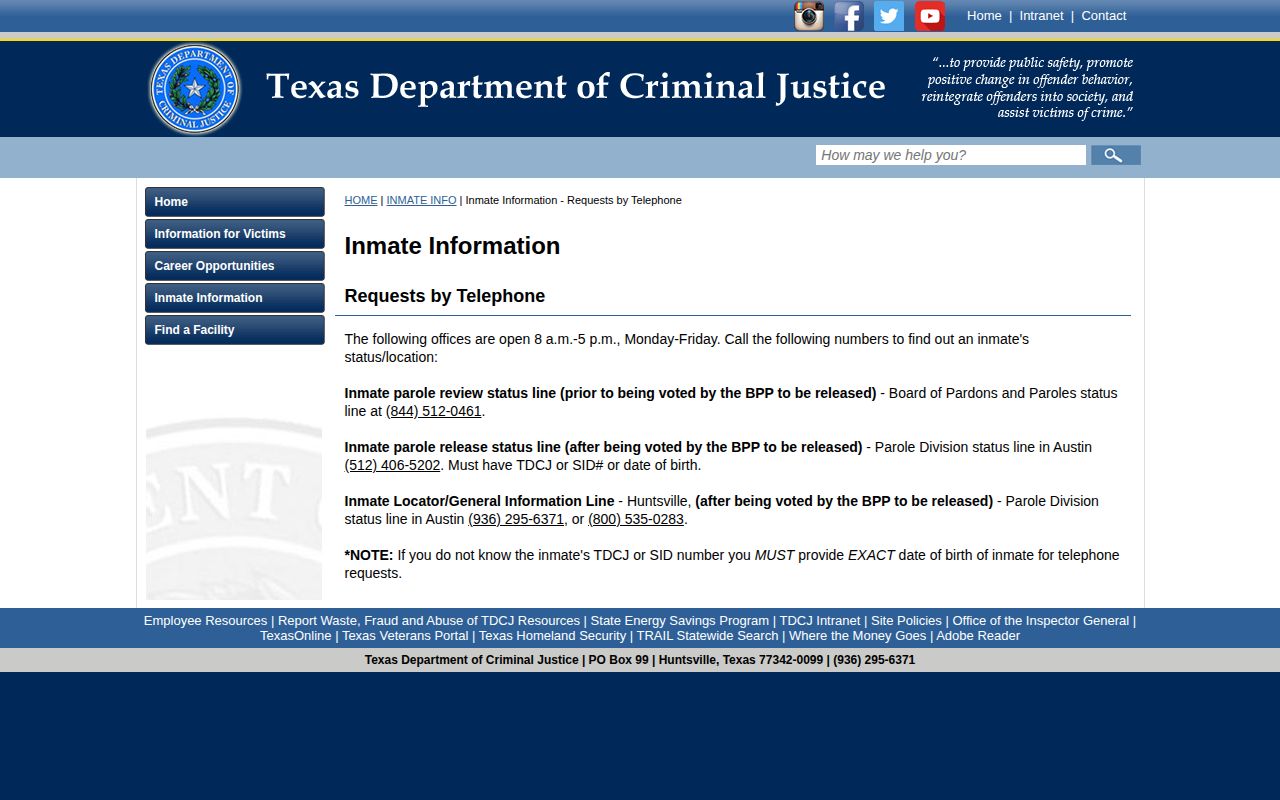
The image supports using the correct call for the person’s stage instead of treating eligibility or approval as completed release.
Sutton County Supervision Violations
Conditions are the rules attached to parole, mandatory supervision, or probation. Their exact terms come from the supervising authority and case record. An alleged violation may lead to agency action, a warrant, a hearing or other process, and possible renewed custody. The public label alone does not establish what was alleged or how the matter ended.
No Sutton County government absconder list was found. An absent name on a jail source or a stale third-party page cannot prove absconder status. Verify a claimed warrant through the correct supervision agency and the relevant court or law-enforcement record. For probation, use the CSCD and court case. For parole or mandatory supervision, use TDCJ and the assigned parole route.
VINELink can supplement awareness of a custody change because the Sutton County Sheriff points to that service. It remains secondary. Available events depend on the reporting agency, and lag or outages may occur. A notification does not replace the parole system’s authoritative review and supervision status.
Note: “Absconder” describes an allegation and agency status; it should not be inferred from silence in an unrelated public search.
Sutton County Supervision Law
Texas Government Code Chapter 508 governs parole and mandatory supervision. Section 508.145 contains parole-eligibility rules, while Section 508.149 identifies many cases that are ineligible for mandatory supervision and supplies the discretionary-review standard. Current serious-offense references use Code of Criminal Procedure article 42A.054, not the retired “3g” label as though it were current law.
Eligibility is only the point at which review may occur. It does not promise release. Likewise, leaving prison on parole or mandatory supervision is release from incarceration but not completion of the sentence. The person remains a releasee until discharge or another status change. A return warrant or revocation can lead to renewed custody.
Sutton County Probation Records
A Sutton County court judgment is the key document for probation. Search by party and cause number when possible, then obtain the judgment, sentence, docket sheet, or later order that addresses community supervision. County court handles misdemeanor criminal matters, while district court handles felony matters. The county’s documented online boundary begins in 1992; older records require the local manual or form route.
The Clerk does not conduct civil or criminal searches by phone. That restriction differs from calling an office to confirm where an existing supervision question should go. Court material can show that probation was imposed, modified, revoked, or completed, but public access may vary and exact status should still be checked with the supervising department.
Probation should not be described as release from TDCJ unless the record independently shows a state-prison event. It is court-ordered community supervision. The multi-county CSCD, not San Angelo’s parole office, handles the ordinary reporting route for a Sutton probation case.
Sutton County Supervision Discharge
Discharge is not a synonym for walking out of prison or jail. TDCJ defines discharge as completion of the sentence and release from incarceration, parole, mandatory supervision, or community supervision. A person may leave prison on parole years before that later date. The two records answer different questions.
For a TDCJ history, request existing records that show admission, actual release, release type, discharge if different, and parole or mandatory-supervision dates and status. For probation, use the court record and the CSCD route. A court order explains legal status; the administering agency confirms the supervision path it controls.
Sentence completion also does not by itself erase the arrest or court file. Expunction and nondisclosure have separate statutory rules. A status statement should remain precise: released from incarceration, released to supervision, discharged from sentence, and released from all custody are not interchangeable claims.